
Specialist service
K9 security units and dog handlers
NASDU-assessed handlers and trained security dogs for construction sites, vacant property, warehousing and events across London and the Home Counties.
A handler and dog team covers ground that static guarding cannot. One team can patrol a perimeter that would need several officers to watch properly, detect people who are already hiding on site, and end most intrusions before they become an incident, because the overwhelming majority of trespassers leave the moment they know a dog is working.
That deterrent only holds if the team is credible. A dog that is poorly handled, visibly unfit or out of control is a liability: it puts your site at legal risk, it puts the handler and any member of the public at risk, and it does not deter anyone who has seen a real working dog. This is why the standards below matter more than the price.
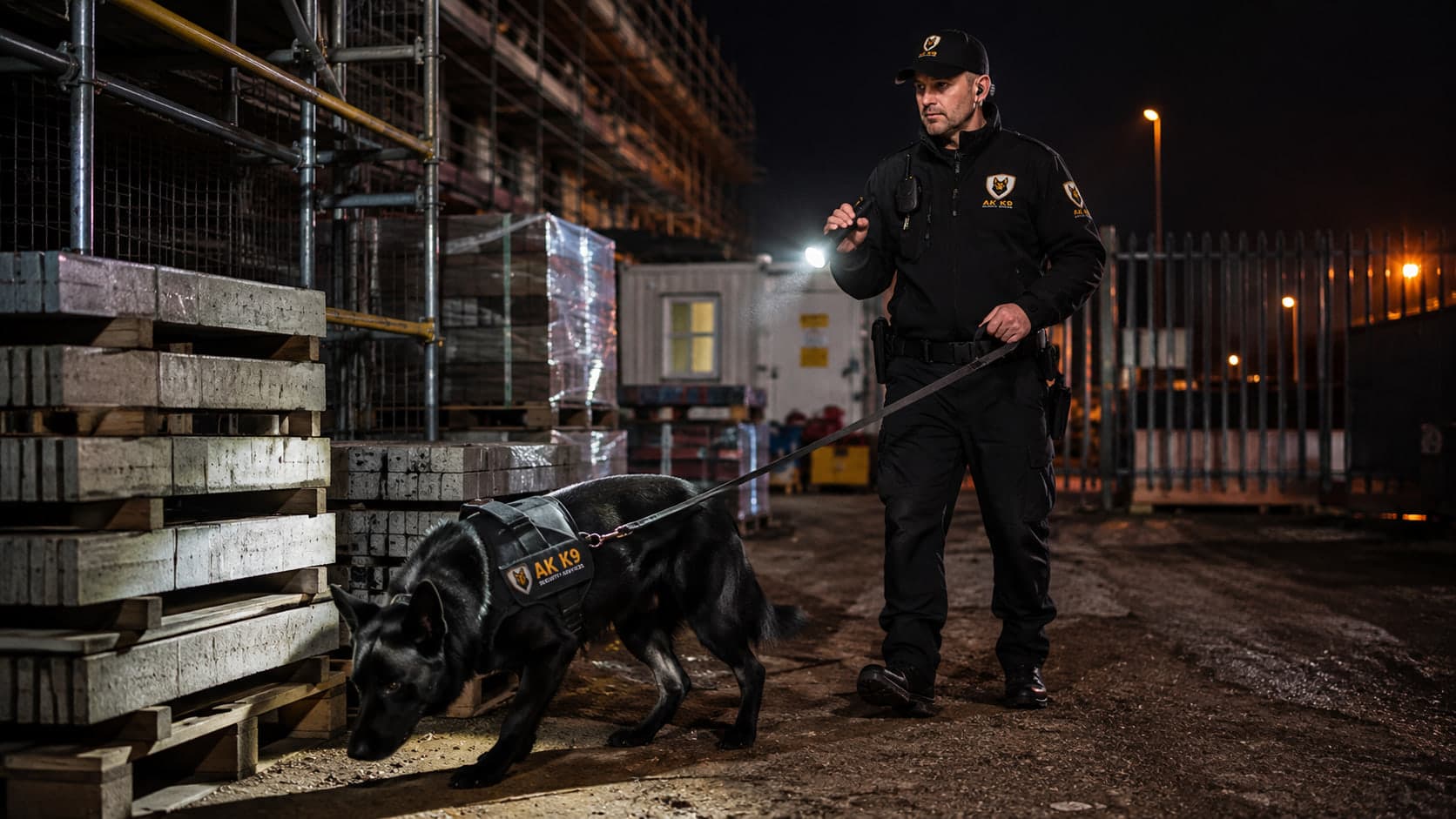
How our dog units are trained and assessed
Our handlers are trained and assessed against the standards of NASDU (the National Association of Security Dog Users) and hold current SIA licences. Every handler and dog works as a bonded team: the same handler with the same dog, because a handler who has been given an unfamiliar dog for a shift cannot read it, and a dog that does not know its handler will not work reliably.
Deployment follows BS 8517, the British Standard covering the use of detection and general purpose security dogs. In practice that governs how the team is briefed, how the dog is transported and rested, how much continuous working time is reasonable, and what happens if the dog indicates on something.
The Guard Dogs Act 1975 sets the legal baseline: a handler must be present and in control of the dog at all times while it is on site. Dogs are never left on a property unattended. If a contractor offers you an unattended dog as a cheaper option, they are offering to break the law using your premises.
What a dog unit actually does on shift
A shift starts with a briefing against the site plan: access points, known problem areas, anything reported since the last patrol, and who to contact. The team then works a varied patrol pattern rather than a fixed circuit, because a predictable route is one anybody watching the site can time.
Patrols cover the perimeter, internal voids, plant and material stores, and any area flagged in the survey. The dog does the detection work: it will find someone concealed in a part-built structure, behind stacked material or in undergrowth far faster than a person with a torch, and in conditions, darkness, wind, rain, where human senses are close to useless.
On finding someone, the priority is a controlled outcome, not a confrontation. In most cases the presence of the team is enough and the person leaves. Where it is not, the handler withdraws to a safe position, contains the situation and calls it in. Everything is logged: times, locations, what was found, what was done, and who was notified.
Welfare, and why it is a client issue too
Dog welfare is not a separate concern from service quality; it is the same concern. Working hours, rest, water, and vehicle temperature are all managed and recorded. A dog that has been in a hot van for hours is not detecting anything, and a handler covering a double shift is not either.
It also protects you. Welfare failures attract local authority attention, and a client whose site is the location of one does not escape the reputational part of it. Ask any dog contractor how they manage vehicle temperature and rest periods; the quality of the answer tells you what you are buying.
Sectors we provide this for
- Construction
- Part-built structures are the hardest sites to search on foot. A dog finds someone concealed in a stairwell or behind stacked material in seconds.
- Vacant property
- Large or multi-floor empty buildings that would need several static officers to hold can be covered by one handler and dog.
- Warehousing and logistics
- Long perimeters and multiple gates. The dog searches the interior as well as confirming the fence line.
- Events and festivals
- Search capability plus visible reassurance. Detection dogs where the risk profile justifies them.
- Rural land and compounds
- Poor natural surveillance and no lighting. Detection matters more than deterrent signage where nobody is watching.
- Transport and rail
- Linear sites with long unobserved stretches and high-value cable.
Dog unit or static officers: which does your site need?
A dog unit is not automatically the better option. It depends on the shape of the site and what you need the security to actually do.
A dog unit fits when
the perimeter is long, the site has voids or structure to search, lighting is poor, or you need one team to cover ground that would otherwise take three or four officers. Also when detection matters: finding someone already on site rather than stopping them arriving.
Static officers fit better when
the site has a gate that needs manning through the working day, deliveries and contractors to process, inductions to check, or a public-facing role. A dog is wasted on a gatehouse.
Both, at different times
is common on active construction: static cover during working hours for access control, then a dog unit overnight when the site is empty and the risk changes from process to intrusion.
If you are choosing on price alone, a dog unit usually covers more ground per pound on a large or unlit site, and static cover is better value where the work is controlling people rather than finding them. A survey settles it in twenty minutes.
Areas we cover for k9 security units and dog handlers
We work across London, Hertfordshire, Bedfordshire and Buckinghamshire. These are the areas with a dedicated page, and there is local detail on each rather than the same text with the place name changed.
Most intrusions end the moment a trespasser knows a dog is working. The deterrent does the job, provided the team is credible enough to be believed.
Typical deployments
- Construction sites holding plant, copper, cable and fuel overnight
- Vacant commercial and residential property at risk of squatting or stripping
- Warehouse, yard and industrial perimeters too large for static guarding
- Events and festivals needing crowd reassurance and search capability
- Rural land, agricultural sites and compounds with poor natural surveillance
- Short-notice cover after a break-in, while physical security is repaired
Compliance
All K9 deployments operate under BS 8517 and the Guard Dogs Act 1975, with NASDU-assessed handlers holding current SIA licences. Licence numbers for personnel assigned to your site are available on request.
Tell us about the site
Send us the property, the hours you need covered and anything that has already happened there. We will come back with a survey date and an honest view of what the site actually needs.